

- Studio Vektor
- Interactive eBooks
- Profound: The Marketing Team of the Future
Case study · Interactive blueprint
The Marketing Team of the Future, from blueprint to role-by-role demos
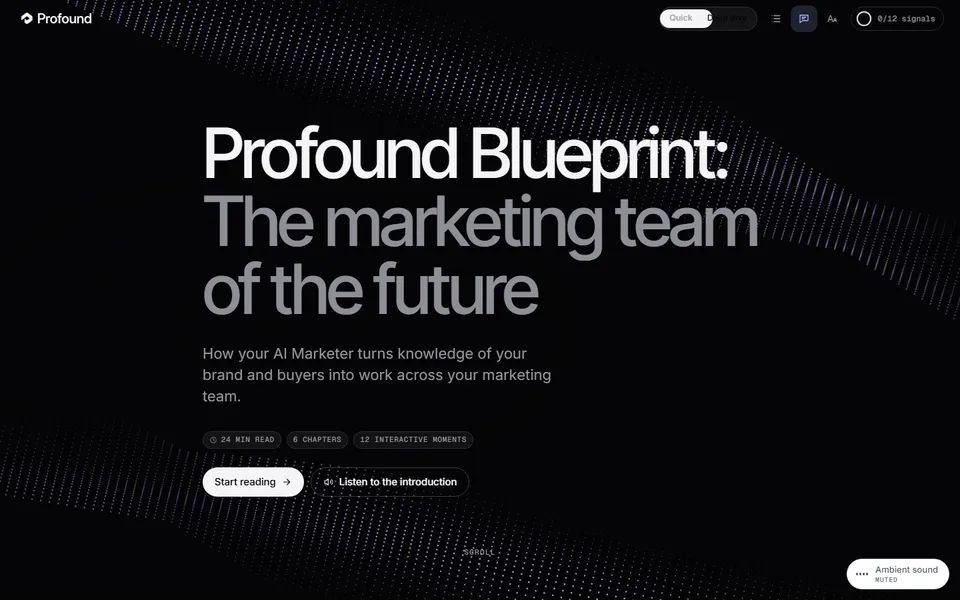
Profound’s blueprint describes how an AI marketer changes each job on the team. The interactive edition lets readers pick their role and run a working demo of the job it changes, from diagnosing a visibility drop to building a campaign brief from a buyer’s prompt.
- Publisher
- Profound
- Original format
- 18-page PDF blueprint
- Edition
- 6 chapters, 12 interactive moments
- Status
- Independent portfolio demonstration
An interactive edition of a blueprint Profound published. The blueprint’s text is as published; the gists, author reflections, models, example data and quiz were written for this edition by Studio Vektor. Not commissioned by, affiliated with or endorsed by Profound. Brands, figures and libraries in the demos are examples.
The starting point: a blueprint in image form
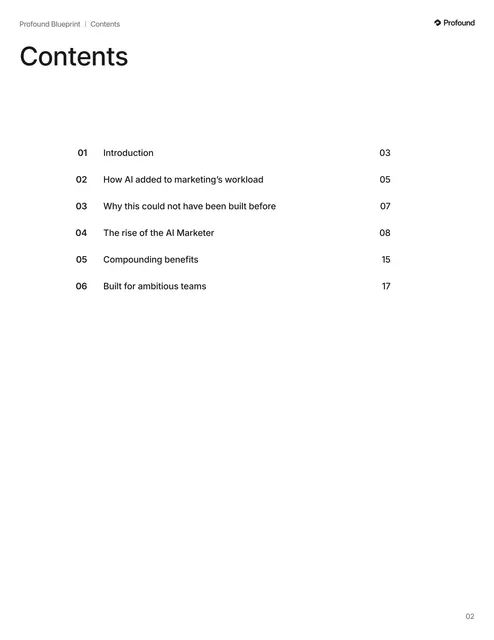
The blueprint argues that as AI makes products easier to copy, marketing becomes the most valuable thing a company does, and that an AI marketer working from a team’s own data and context can take on the work around the draft. In print it is 18 pages, and its text is set as images, so it can’t be searched, selected or read aloud by assistive technology.
The brief
A blueprint about doing the work should show the work being done. The edition had to make each claim concrete for each role.
Show the scale
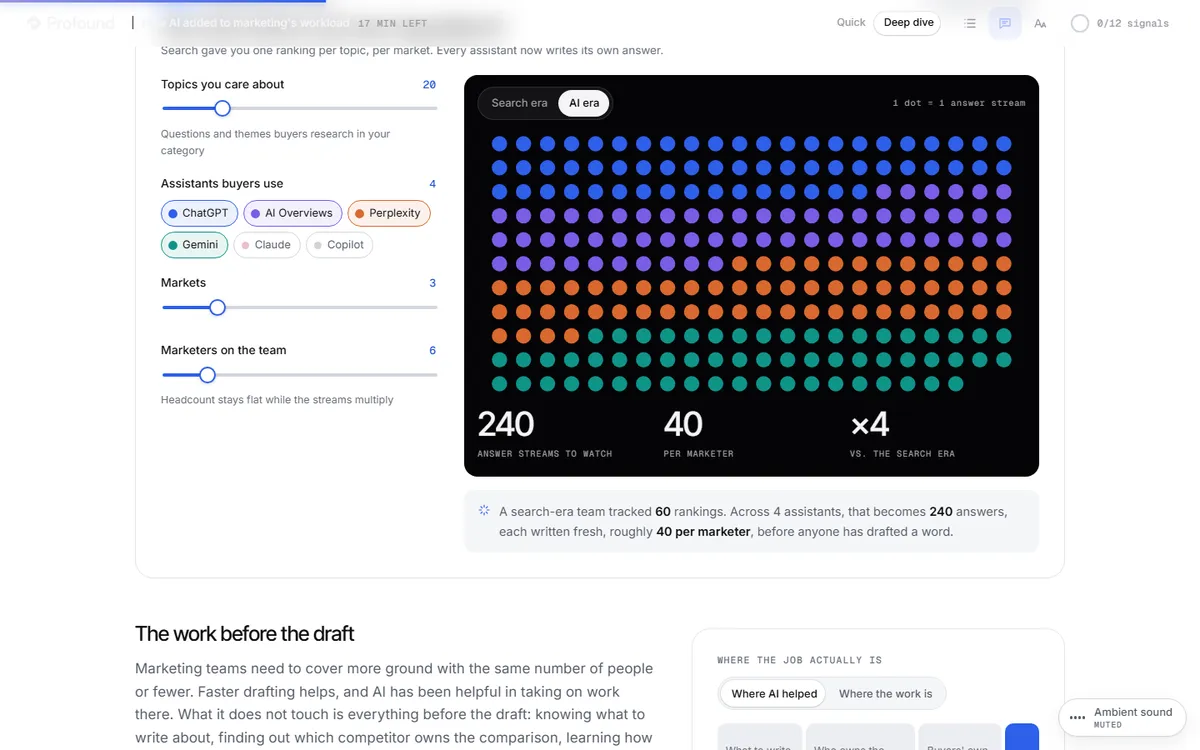
Model how many AI answers a team is now responsible for, by topics, assistants and markets.
Demonstrate by role
Give each of five roles a working demo of the job the AI marketer changes.
Make it accessible
Turn image-set pages into real, searchable, listenable text.
Who it is for
Marketing leaders and the specialists on their teams.
CMOs
Read the argument fast on the Quick track and see why context compounds.
SEO, content and demand teams
Pick their role and run the demo of their own job.
Product marketing and comms
See how assistants describe brands and which outlets they quote.
From PDF to edition, chapter by chapter
The edition follows the blueprint’s argument in order.
| Chapter | The blueprint’s point | In the interactive edition |
|---|---|---|
| Introduction | AI makes products easier to copy; marketing is what compounds | A read-aloud introduction and a choice of Quick or Deep-dive track |
| 1 · How AI added to marketing’s workload | Every assistant writes its own answer | A model of how many answers a team is responsible for, and the work before the draft |
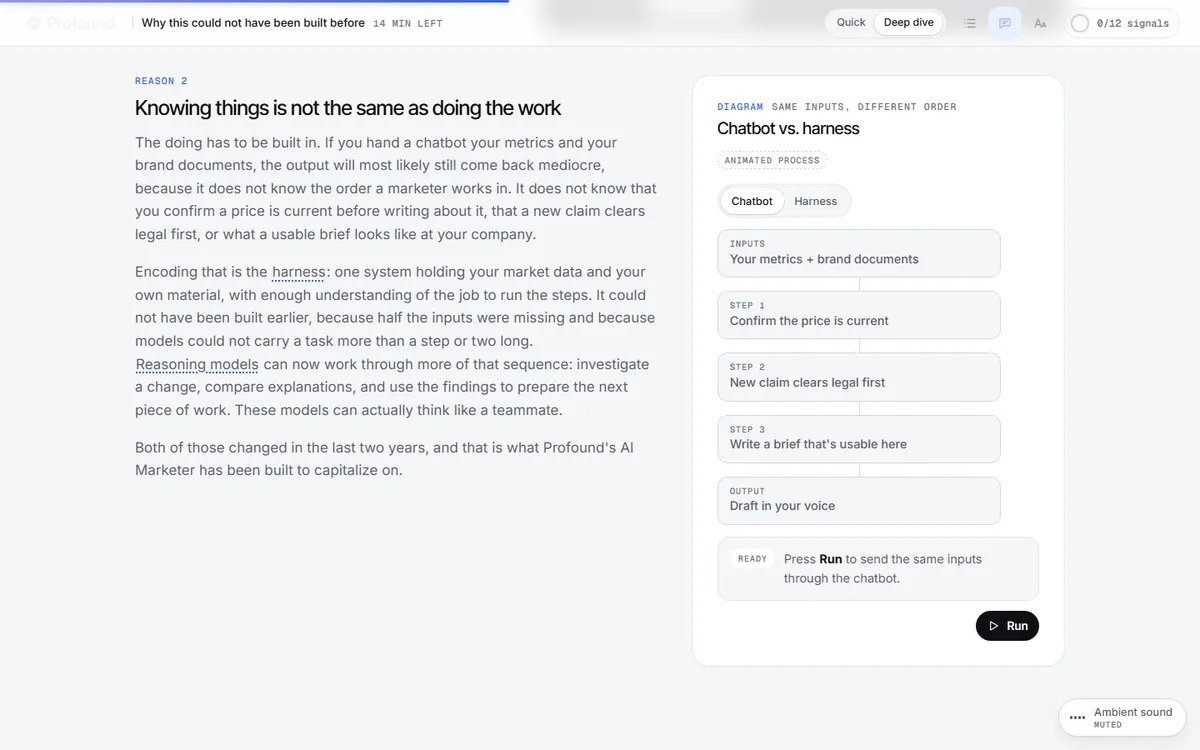
| 2 · Why this could not have been built before | Nobody could see what buyers asked AI; knowing is not doing | An animated chatbot-versus-harness comparison |
| 3 · The rise of the AI Marketer | One system holding strategy, audience, company, offerings and market context | An inputs map and a demo of the AI marketer handing work back |
| 4 · By role | What changes for SEO, content, demand generation, product marketing and communications | Five role demos, each with example data |
| 5 · Compounding benefits | Context advantage compounds; model advantage resets | A year-long model of which advantage survives each model release |
| Checkpoint and close | Built for ambitious teams | Five questions and the closing call to action |
What Studio Vektor did
Turned a static blueprint into a set of working demonstrations.
Modelled the workload
Topics, assistants, markets and team size produce the number of answer streams each marketer has to watch, compared with the search era.
Showed the harness
An animated process runs the same inputs through a chatbot and a harness that confirms the price, clears legal and writes a usable brief.
Built five role demos
Diagnose a visibility drop in four steps, filter a content library, build a brief from a buyer’s prompt, compare how assistants describe brands and rank outlets by how often they’re quoted.
Made it readable
The image-set PDF became live text with narration, tracks and reading settings.
Key interactives
Twelve interactive moments, all kept in both reading tracks.
| Interactive | Type | What the reader does |
|---|---|---|
| How many answers? | Illustrative model | Sets topics, assistants, markets and team size to count answer streams |
| Chatbot vs. harness | Animated process | Runs one set of inputs through a chatbot and a harness |
| The AI Marketer’s inputs | Explainer | Explores where each kind of context comes from |
| Visibility fell 8 points | Role demo · SEO or AEO | Steps through trend, assistant, topics and the actual text |
| Which pieces still work? | Role demo · Content | Filters a 36-piece example library by cited, crawled or untouched |
| Build the brief | Role demo · Demand generation | Taps parts of a buyer’s prompt to build a campaign brief |
| How assistants describe each brand | Role demo · Product marketing | Compares a brand with the category leader over time |
| Prestige or quotes? | Role demo · Communications | Re-ranks outlets from prestige to times quoted |
| What’s left after the next release? | Illustrative model | Drags through a year to compare model and context advantage |
| Five questions | Quiz | Checks the blueprint’s main ideas |
Reading experience and accessibility
Eighteen image-set pages become one responsive, searchable edition.
Two tracks
Quick opens each chapter with a gist card and folds the long passages; Deep-dive keeps every word.
Listen along
Narration of the introduction using the reader’s device voice.
Reading settings
Text size, Auto, Light, Dark and Sepia themes, dyslexia-friendly type (Atkinson Hyperlegible) and bionic emphasis.
Real text
Unlike the image-set PDF, every word can be searched, selected and read by assistive technology.
Announced results
Ten live regions announce demo and quiz results.
A print stylesheet for the full edition.
Design system
Profound’s near-black and white with a single strong blue for everything interactive.
- Night
#050507Cover and dark panels - Profound blue
#2E5FEAActions, selections and highlights - Blue soft
#EBF0FEWidget backgrounds - Ink
#0E0F12Text - Paper
#F5F6F8Reading background
Type
Inter Tight for display, Inter for reading, Geist Mono for data and labels, and Atkinson Hyperlegible for the dyslexia-friendly mode.
Restraint
One accent color keeps attention on the demos and the data.
Example data, labelled
Every demo says that its brands and figures are examples.
How it’s built
Role demos are separate modules, so a new role can be added without touching the rest.
| Aspect | Approach |
|---|---|
| Delivery | One self-contained HTML file (about 230 KB) with its images embedded. No platform, plugin or reader app. |
| External requests | The web fonts, with system-font fallbacks, and a page-view analytics tag |
| Narration | The reader’s device voice through the Web Speech API, with word or sentence tracking |
| State | Answers, progress and settings saved in the reader’s browser |
PDF vs interactive edition
The PDF is a set of images. The edition is a working tool.
| Question | Original PDF | Interactive edition |
|---|---|---|
| Can I search or select the text? | No, it’s set as images | Yes, and it can be read aloud |
| What does this mean for my job? | One section per role | A working demo for each role |
| Why does context matter? | An argument | A year-long model to drag through |
| Did I take it in? | No check | A five-question quiz |
What we would measure
This edition is an independent demonstration with no audience data, and we don’t report results for it. For a marketing-software company, role choice is a strong signal of who is reading.
Role mix
Which of the five roles readers pick.
Depth
Demos completed and track choice.
Intent
Quiz completion and clicks to the product.
Where this approach fits
Content written for several roles at once benefits from letting readers choose theirs.
Multi-role guides
One edition, a demo for each reader’s job.
Image-heavy PDFs
Designed pages that need to become accessible, searchable text.
Product-led thought leadership
Arguments best made with a working example.
FAQ
Common questions about this edition and projects like it.
Was this edition commissioned by Profound?
No. It is an independent portfolio demonstration built from a blueprint Profound published. The blueprint is Profound’s; the editorial layer, interactions, design and build are Studio Vektor’s.
Are the brands and figures in the demos real?
No. The demos use example brands, libraries and figures to show how each job changes, and are labelled as examples.
What would an edition like this cost?
Interactive eBooks start from $635, and the Advanced package with one defined quiz or scoring tool and interactive charts starts from $1,170. An edition at this depth, with twelve interactive moments and five role demos, goes beyond those packages and is quoted on scope after we see your document.
Can we add roles later?
Yes. Each role demo is a separate module, so new roles or updated demos can be added without rebuilding the edition.
Writing for several roles?
Let every reader see their own job change.
Multi-role guides and product-led thought leadership work well. Send the PDF and we’ll show you how.